
How to Read Pokemon Cards: Visual Anatomy Guide
Learn how to read Pokemon cards step by step: HP, Stage, attacks, Abilities, Energy costs, Weakness, Retreat, set code, rarity, and regulation mark.
Quick answer
Table of Contents
Key takeaways
- The 30-second card-reading checklist
- Top of the card: identity and evolution
- Pokemon name
You can read almost any Pokemon card in the same order: identity at the top, gameplay in the middle, and identification details along the lower edge. The artwork may change dramatically, but the card text is what determines how it works.
This guide was checked against official Pokemon TCG resources on August 27, 2026. When a card and a general explanation disagree, follow the exact wording on the card and the current official rulebook.
The 30-second card-reading checklist
- Name, HP, Stage, and Pokemon type.
- Ability text, including when and how often it applies.
- Attack cost, name, damage, and effect.
- Weakness, Resistance, and Retreat Cost.
- Rule box, if the card has one.
- Expansion code or symbol, collector number, rarity, and regulation mark.
That order separates gameplay questions from collecting questions and prevents common mistakes such as confusing HP with attack damage or rarity with price.
Top of the card: identity and evolution
Pokemon name
The name identifies the Pokemon for deck-building rules and card effects. Extra labels such as ex, V, VMAX, or a Trainer’s name are part of the printed name or card category and can change which rules apply.
Do not identify a card by name alone. Popular Pokemon have many printings with different attacks, artwork, sets, and prices.
HP
HP is how much damage the Pokemon can have before it is Knocked Out. Damage counters remain on the Pokemon until an effect removes them, it leaves play, or another rule applies.
HP is not attack damage, a rarity score, or a price indicator. There is no useful universal HP range by evolution stage: card design changes across eras and special mechanics.
Stage and “Evolves from”
A Pokemon card normally says Basic, Stage 1, or Stage 2 near the top:
- A Basic Pokemon can be played directly to the Bench during your turn.
- A Stage 1 names the Basic Pokemon it evolves from.
- A Stage 2 names the Stage 1 it evolves from.
Some mechanics add their own evolution or play rules. Read the card’s rule box and the current official Pokemon TCG rules rather than assuming every special card evolves in the same way.
Pokemon type
The type symbol beside the HP identifies the Pokemon’s TCG type. It does not automatically tell you the Energy required for every attack or the Weakness of every opponent. Those instructions are printed separately.
Middle of the card: artwork, Abilities, and attacks
Artwork and illustrator
The illustration identifies the visual printing, while the illustrator credit is usually near the lower edge. Alternate-art and special-treatment versions can share gameplay text with another card but still be separate collectibles.
For identification, match both the artwork and the collector details. For gameplay, use the printed text.
Abilities
An Ability is an effect distinct from an attack. The Ability text tells you:
- Whether it is activated or continuous.
- Whether the Pokemon must be Active or can be on the Bench.
- When it can be used.
- How often it can be used.
- What prevents or ends the effect.
There is no safe general rule that every Ability works from the Bench or can be used multiple times. Phrases such as “once during your turn,” “when you play this Pokemon,” and “as long as this Pokemon is in the Active Spot” are functional instructions.
Older cards can use historical labels such as Pokemon Power or Poke-Power. They should not automatically be treated as identical to a modern Ability.
Attack cost
The Energy symbols to the left of an attack are the cost for that attack:
- A specific symbol requires that type of Energy to be provided.
- A Colorless requirement can be covered by Energy of any type unless another effect says otherwise.
- A Special Energy card provides only what its own text says it provides.
The Pokemon’s type does not replace the printed attack cost.
Attack name, damage, and effect text
Read an attack as one complete instruction:
- Pay or satisfy the Energy cost.
- Note the attack name.
- Start with the printed damage, if any.
- Resolve the effect text in the order written.
- Apply Weakness, Resistance, and other effects according to the rules.
A blank damage box does not mean the attack does nothing; its effect may be entirely in the text. Symbols such as + or × next to a number tell you that the final damage depends on the stated condition.
Do not skim words such as may, then, if, before, during your next turn, or your opponent’s Active Pokemon. They define choices, sequence, timing, and targets.
Bottom gameplay row: Weakness, Resistance, and Retreat
Weakness
Weakness shows a Pokemon type and a modifier such as ×2. Apply the modifier printed on the card. Do not use a video-game type chart or assume that every printing of the same Pokemon has identical Weakness.
Resistance
Resistance shows a type and a reduction when the card has one. Some cards have no Resistance. The printed modifier and current rules determine when it applies.
Retreat Cost
Retreat Cost shows how much Energy must normally be discarded from the Active Pokemon to move it to the Bench. Colorless symbols count the required Energy; no printed symbol means a base retreat cost of zero. Other cards can increase, reduce, or replace that cost.
Lower edge: set, card number, rarity, and regulation
These fields identify the exact printing.
Expansion symbol or code
Older English cards commonly use a pictorial expansion symbol. Beginning with Scarlet and Violet, English cards use an expansion code in the lower-left area instead. Position can vary by era, so search the lower edge rather than relying on one universal corner.
Collector number
A number such as 057/191 identifies the card within its expansion checklist. The first number is the card; the second is the printed checklist total. Overnumbered cards exist, but their official rarity name depends on the era and set.
Rarity
Circle, diamond, and star marks traditionally indicate Common, Uncommon, and Rare. Modern sets add multi-star and foil-star categories. The Pokemon card symbols guide explains the current system.
Rarity describes a print category. It does not tell you the card’s exact market value.
Regulation mark
The regulation letter helps determine competitive legality. In the 2026 Standard format, H, I, and J are legal as of this update; G rotated out. Functional reprints can create exceptions, so check the official 2026 rotation guidance before an event.
Rule boxes and special card labels
Cards such as Pokemon ex include a rule box that changes the consequences of using that card. For example, the current Pokemon ex rule awards the opponent two Prize cards when that Pokemon is Knocked Out.
Read the rule box rather than estimating from the card’s HP, artwork, or rarity. A normal Pokemon ex can be Double Rare; “ex” does not mean the card must be Ultra Rare.
The same principle applies to historical Pokemon-EX, Pokemon-GX, Pokemon V, VMAX, VSTAR, Radiant Pokemon, Prism Star cards, and newer mechanics. Similar names do not make their rules interchangeable.
Worked modern example: Pikachu ex from Surging Sparks
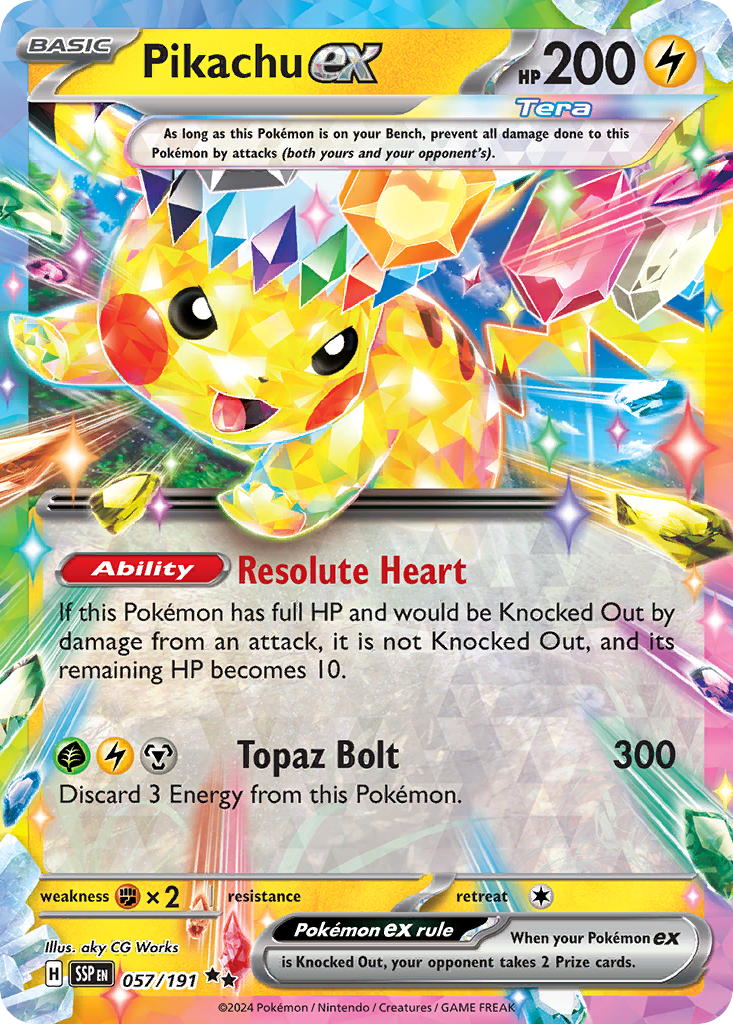
Open the exact Pikachu ex card page and read it in order:
- Pikachu ex is a Basic Lightning-type Pokemon with 200 HP.
- It has the Tera and ex labels, so its Ability and rule box matter.
- Resolute Heart is conditional text, not an attack you choose from the attack row.
- Topaz Bolt requires Grass, Lightning, and Metal Energy and prints 300 damage. The effect also instructs you to discard three Energy from the Pokemon.
- Its Weakness is Fighting ×2, it has no printed Resistance, and its Retreat Cost is one Colorless.
- SSP 057/191 identifies the Surging Sparks printing.
- Two solid black stars identify Double Rare.
- Regulation mark H is legal in the 2026 Standard format as of this update.
This example shows why the Pokemon’s Lightning type does not determine the attack cost: Topaz Bolt requires three different Energy types.
Historical layouts: use the same logic, expect different labels
A Base Set Alakazam is useful for learning card history, but it should not be used as the only template for a modern card:
- It uses the historical Pokemon Power label.
- Its set identification follows the early Wizards-era layout.
- English Base Set has no expansion symbol.
- Its wording and visual hierarchy differ from current cards.
The reading sequence still works: identity, gameplay text, Weakness/Resistance/Retreat, then exact printing details. When an old term is unclear, check the official card database, errata, and current rules.
How card anatomy connects to value
Card anatomy helps you identify the product being priced; it does not calculate value by itself. HP, attack damage, or a star cannot tell you what a buyer will pay.
Before checking a price, match:
- Expansion and collector number.
- Artwork and foil treatment.
- Language.
- Raw condition or professional grade.
- Any stamp or promotional variant.
Then use the Price Checker and read the pricing methodology. For the full process, see How Much Is My Pokemon Card Worth?.
Common reading mistakes
- Confusing HP with damage. HP is durability; attack damage is printed beside an attack.
- Assuming type equals Energy cost. Read each attack’s symbols.
- Applying a universal type chart. Use the printed Weakness and Resistance.
- Treating every Ability the same. Timing and location restrictions are in the text.
- Skipping an attack’s effect. Damage may be conditional or followed by a required action.
- Calling every star an Ultra Rare. Modern star count, color, and finish matter.
- Using the set mark for legality. Regulation marks and current rules control Standard eligibility.
- Pricing the wrong printing. Name alone is not enough.
Frequently asked card-reading questions
Does Colorless mean I need a Colorless Energy card?
No. A Colorless attack or Retreat requirement can normally be met by Energy of any type. Always account for card effects that change what an attached Energy provides.
Can every Ability be used from the Bench?
No. Read the Ability’s exact text. Some require the Active Spot, some work from the Bench, some trigger once, and others are continuous.
Does a number above the set total mean Secret Rare?
It identifies an overnumbered card, but the official rarity name depends on the set and era. Confirm it using the expansion checklist.
How do I identify a card if several versions use the same artwork?
Use the expansion code or symbol, collector number, language, foil treatment, and any stamp. The set symbol finder and Explore can narrow the match.
Can I tell a card’s value from the front?
You can identify clues, but not a reliable price. Exact printing, condition, variant, market, and recent completed-sale data all matter.
Methodology
Sources
Related Tools & Next Steps
Track the Cards You Research
The web is great for quick answers. The app is where you scan cards, track value, and manage the collection you actually own.
Download MyDex TCG